
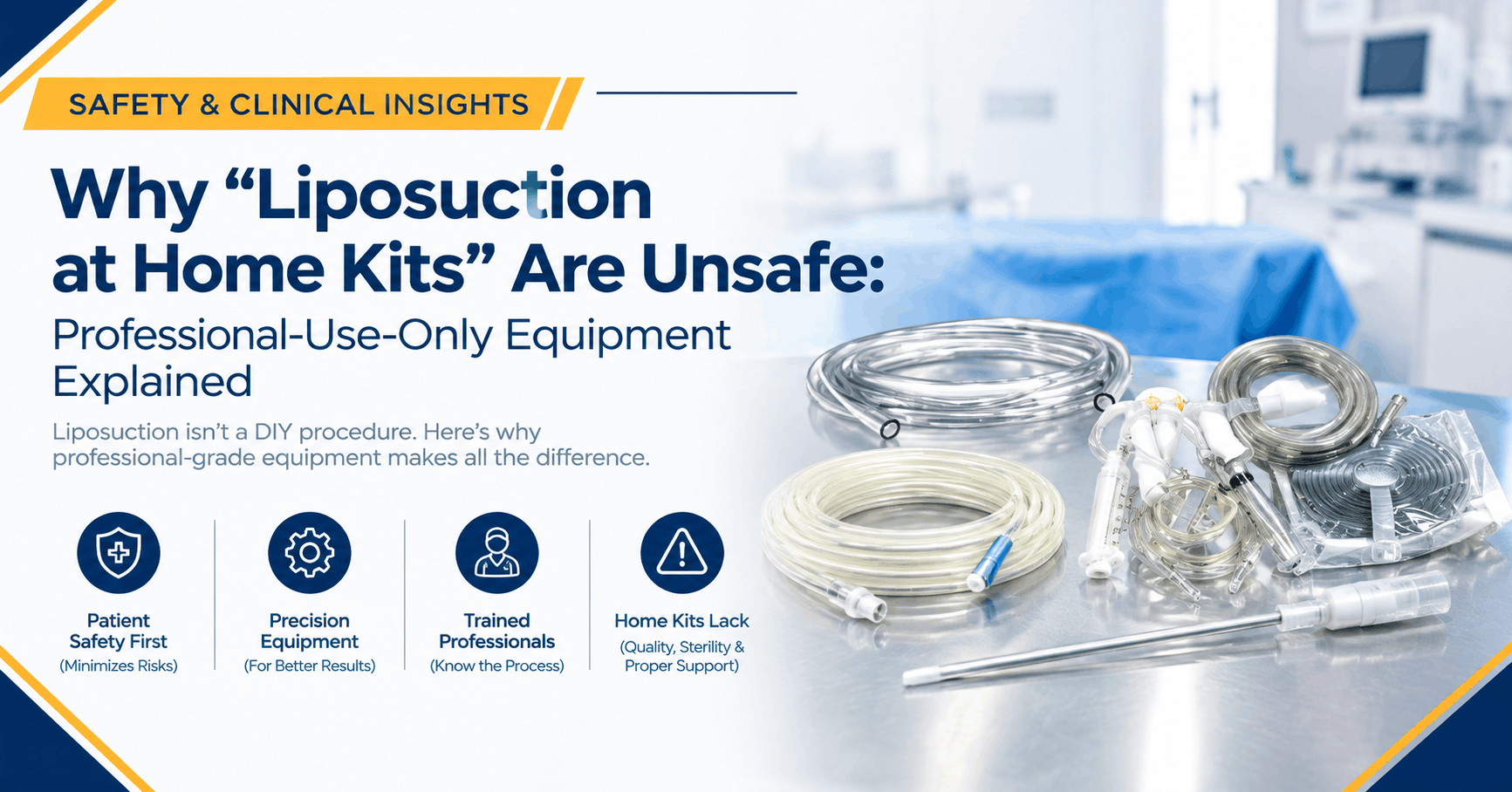
Look, the pitch is tempting. You scroll through a listing, see a suction device, a cannula, some surgical accessories, and it’s framed like just another DIY beauty tool you can order and use yourself. But here’s the reality check: a liposuction at-home kit can’t give you the one thing that actually matters most — a trained person, a sterile room, and someone ready to step in if things go sideways. You can’t order that part on Amazon.
This isn’t “stick a tube in and suck the fat out.” That’s a fantasy version of what’s actually a serious surgical procedure. Real liposuction takes anatomical know-how, steady hands with real instrument control, careful anesthesia management, and constant monitoring. Once you actually understand what’s involved behind the scenes, the risks of trying this at home start to speak for themselves.
Liposuction Is a Surgical Procedure — Full Stop
Liposuction is cosmetic surgery. It targets specific fat deposits to reshape particular areas — it’s not a weight-loss hack, and it’s definitely not something you wing. It takes a proper medical evaluation, real surgical skill, and aftercare that actually gets followed through.
What goes on in a real, clinical liposuction
Before any cutting happens, the surgeon sits down with you — goes through your medical history, talks about what you actually want out of it, and figures out whether you’re even a reasonable candidate in the first place. Depending on how they’re approaching it, you might get local anesthesia, sedation, or go under general anesthesia entirely.
Then come the small incisions, and a cannula connected to a proper suction setup removes the targeted fat. The whole time, there’s a team watching you, ready to catch complications before they become emergencies. Once it’s done, you get real recovery instructions and someone checking in on you afterward.
A liposuction at-home kit? None of that comes with it. You’re on your own.
Why training, anesthesia, and sterility aren’t “nice to haves”
You need to actually know where the blood vessels are, how the tissue behaves, and how to move an instrument without wrecking something nearby. Mess that up, and you could be looking at serious bleeding or damaged structures before you even realize what’s happening.
Anesthesia is its own minefield — get the dose or the absorption wrong, and you’re risking genuinely dangerous reactions, including ones that hit the heart. And then there’s sterilization. Instruments touching your skin and deeper tissue need to be handled to a standard that just isn’t realistic in someone’s bathroom.
This stuff isn’t about having the right gear sitting on a table. It’s years of training, the right facility, and protocols built specifically to catch the things that can go wrong.
What Can Actually Go Wrong With DIY or At-Home Liposuction
Trying this yourself opens the door to injuries that are genuinely tough to catch — let alone treat — without medical training behind you. Some of these don’t just need a bandage; they need an ER.
Infection and bleeding
Any time an instrument breaks the skin, there’s a real chance of pushing bacteria into deeper tissue if the equipment or the handling isn’t right. That can mean antibiotics, draining an infection, or a hospital bed.
There’s also the blood vessel risk — damage one, and you’re dealing with serious bleeding, or blood pooling under the skin where you can’t even see it clearly. If you’re the one doing the procedure, good luck recognizing how serious that actually is in the moment, let alone having what you’d need to deal with it.
Honestly, these at-home liposuction dangers alone should be enough to rule out doing this yourself.
Injury to organs and tissue
Put the cannula in the wrong spot, and you risk hitting nerves, blood vessels, connective tissue, even organs. Push too hard, or just not know the anatomy well enough, and you end up with skin damage, scarring, or healing that looks nothing like it should.
Small incisions make it feel simple. It isn’t. Knowing exactly how deep to go and in what direction takes real judgment — the kind you build over years, not the kind you absorb from a few videos online.
Anesthetic toxicity and other emergencies you really don’t want
Absorb too much local anesthetic, and you can end up with something called local anesthetic systemic toxicity. In the worst cases, that’s seizures, a heart rhythm that’s gone haywire, or cardiac arrest.
Add to that fluid imbalances, blood clots, breathing trouble tied to anesthesia — the list goes on. A proper clinical setting has the monitoring equipment, the emergency medications, and people trained to act fast. At home, if something goes wrong, you’re genuinely on your own with no backup plan.
Contour results that don’t go the way you wanted
Remove fat unevenly, and you’re looking at asymmetry, lumpy patches, visible dents, sagging skin, scars that never really fade. Take too much from one spot, and you might need a whole other procedure just to undo it.
People attempting this themselves almost always underestimate how much precision it actually takes to get a result that looks balanced — not to mention avoiding tissue damage along the way.
“At-Home Kits” and Devices: The Marketing vs. the Reality
Browse online marketplaces, and you’ll find suction machines, cannulas, and tubing sold like they’re just another cosmetic gadget. But a product being listed for sale tells you nothing about whether it’s actually approved for self-use or safe to use outside a clinical setting.
Why professional surgical disposables were never meant for self-use
Real surgical supplies — aspiration tubing, infiltration tubing, cannulas, connectors — are designed to work as a system, with each piece doing a very specific job within a setup it’s actually compatible with.
A home liposuction machine simply can’t stand in for surgical training, sterile technique, anatomical judgment, or a team watching you during the procedure. Mismatched parts, improper connections, sloppy handling — all of that just adds more ways for something to go badly wrong.
If something says “professional-use only,” believe it. Before buying anything, check the manufacturer’s intended use, its actual regulatory status, and whether it’s genuinely compatible with what you’re trying to do.
Red flags that should make you close the tab
Be wary of anything promising painless fat removal, guaranteed results, or “safe surgery, no doctor needed” — that kind of language is a pretty loud warning sign on its own. Also watch for missing manufacturer details, vague or incomplete instructions, regulatory claims you can’t actually verify, and specs that just don’t add up.
A “medical-grade” sticker doesn’t mean a product is suited to this particular job. If you’re asking yourself, can you do liposuction at home, here’s the honest answer: the fact that something’s available to buy online says nothing about whether performing surgery on yourself is actually a good idea.
What Qualified Professionals Actually Do Differently
Qualified professionals don’t just “know more” — they follow real, established steps to assess patients properly, avoid preventable risks, and manage recovery the right way.
Patient screening that actually means something
The surgeon goes through your medical history, current medications, allergies, past procedures, and what you’re genuinely hoping to achieve. Things like certain health conditions, smoking, and bleeding risk all factor into whether surgery even makes sense for you.
You also get an honest conversation about what results are realistic, what could go wrong, and what else is out there — before you’ve committed to anything.
A controlled, actual clinical environment
A proper surgical setting means sterile instrument handling, safe anesthesia practices, and continuous monitoring throughout. The team follows the manufacturer’s instructions for every single piece of equipment, and there’s an actual plan for handling emergencies if one comes up.
None of this makes every risk disappear — nothing can promise that — but it cuts out a huge amount of harm that’s genuinely avoidable.
Monitoring and aftercare that doesn’t just stop at the door
After the procedure, you might need observation, plus real instructions on wound care, what to avoid doing, and when to come back in. Clinicians keep track of how you’re healing and step in if there’s persistent pain, swelling, or anything that looks like infection.
And if you ever get chest pain, trouble breathing, fainting, or bleeding that won’t stop — that’s not a “wait and see,” that’s get help immediately.
Safer Ways to Explore Body Contouring
Surgery isn’t the only route if you want to change your body shape. Depending on what you’re going for, you might look at exercise, nutrition support, or nonsurgical treatments done by an actual professional. They come with their own trade-offs and won’t necessarily match what liposuction can do — but they’re worth knowing about.
Finding a board-certified plastic surgeon
In the US, you can check someone’s plastic surgery certification through the American Board of Plastic Surgery — it takes five minutes, and it’s worth doing. Also confirm they’re operating out of a facility that’s properly licensed or accredited.
A consultation with a board-certified plastic surgeon liposuction specialist should cover their qualifications, what’s actually realistic for you, the risks specific to your case, recovery, and how they’d handle it if something went wrong. If anyone guarantees results or waves off your questions, that’s your cue to walk.
Questions worth asking before you commit to anything
1. Am I actually a good candidate for this?
2. What results are realistic for my goals, honestly?
3. Which technique would you use, and why that one?
4. What are the biggest risks in my specific situation?
5. Who’s handling anesthesia, and who’s watching me during the procedure?
6. What aftercare and follow-ups are included?
7. What’s the full cost, no surprises later?
Clear, direct answers here make it so much easier to actually compare your options instead of just guessing.
If you’re wondering is diy liposuction safe — no, it isn’t, and that’s not meant to scare you; it’s just the honest answer. Surgical fat removal belongs with qualified professionals, in a real clinical setting. No version of doing it yourself changes that.
A Note for Healthcare Professionals
Where to actually find professional-use liposuction tubing and kits
If you’re a healthcare professional sourcing supplies, take the time to verify intended use, product specs, compatibility, packaging integrity, and the manufacturer’s instructions before you buy. You’re typically looking at things like aspiration tubing, infiltration tubing, cannulas, and the connectors built to match them.
Cellmyx is one provider worth putting on your research list if you’re looking into professional-use liposuction supplies. Review their documentation carefully and make sure each item actually meets your clinical requirements and whatever regulations apply where you practice.
This equipment is meant to be bought and used by qualified people, full stop. Clear labeling and proper handling procedures do a lot of the heavy lifting in preventing misuse.
Bottom Line
A liposuction at-home kit might look like a shortcut — cheaper, more convenient, no waiting rooms. But it simply can’t provide the training, the sterile conditions, the anesthesia management, or the emergency support that surgical fat removal genuinely requires. We’re talking infection, serious bleeding, tissue damage, anesthetic toxicity, and contour problems that might never fully go away.
If you’re thinking about body contouring, start by talking with a qualified surgeon about your options, the risks, and what recovery will really involve. And if you’re a healthcare professional, buy your equipment from reputable suppliers and follow the manufacturer’s instructions. Keeping invasive procedures in qualified clinical hands is the safest way to protect everyone’s health.
FAQs
No, liposuction is not safe to perform at home. It is a surgical procedure that requires proper training, sterile equipment, and clinical supervision. Attempting it yourself can lead to serious infections, excessive bleeding, tissue damage, and potentially life-threatening complications.
Some products are advertised as at-home liposuction kits, but that does not make them safe or suitable for personal use. Surgical equipment sold to medical professionals is designed for clinical procedures, not DIY treatments, which can cause serious harm without proper expertise.
If you are considering liposuction, start by scheduling a consultation with a board-certified plastic surgeon. They can review your medical history, discuss your body contouring goals, explain potential risks, and recommend suitable options based on your health and individual needs.
Liposuction tubing is specialized medical equipment intended for appropriate clinical use. Cellmyx products are intended for qualified medical professionals, not self-treatment. If you are considering liposuction, consult a qualified surgeon rather than purchasing surgical supplies for personal procedures.
