
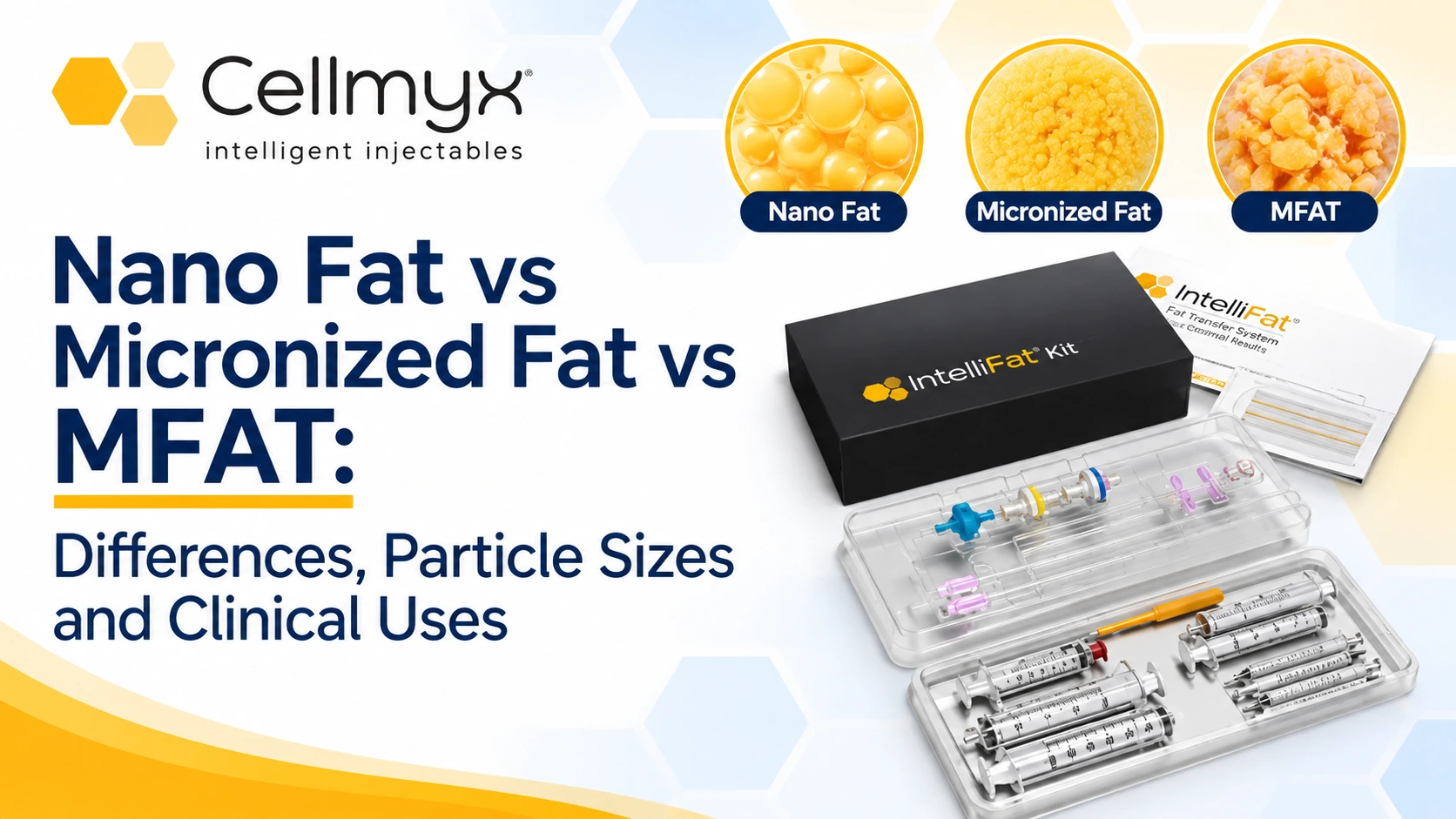
Fat grafting provides a lot of different options for tissue repair and skin improvement. It includes options for volume restoration. Picking the correct method depends on more than just the amount of fat collected.
Particle size and the processing method influence its clinical use. The preservation of tissue structure also influences it. Knowing about nano fat vs. micronized fat helps you pick a much more appropriate processing method based on the treatment objectives and the injection needs.
At a Glance Comparison Table (Particle Size, Intact Adipocytes, Injection Depth, Needle Gauge, Typical Uses)
Feature | Nanofat | Micronized Fat (MFAT) |
| Particle size | Very fine, commonly below 0.1 mm by classification | Around 500 µm in certain systems |
| Intact adipocytes | Mostly disrupted | Tissue clusters retain structural components |
| Injection depth | Superficial dermal layers | Deeper soft tissue, depending on indication |
| Needle gauge | Fine needles or small cannulas | Larger-bore needles or cannulas |
| Typical uses | Skin quality, scars, fine lines | Tissue support and regenerative procedures |
Particle sizes, injection depths, and the needle gauges are different depending on the processing system, treatment indication, and the clinical protocol. The values shown are just general references and not universal standards.
Fat Grafting Terminology: Macrofat, Microfat, Nanofat, Micronized Fat and MFAT
Fat grafting uses the processed adipose tissue for different clinical purposes. The terms describe the differences in the tissue size and structure. It also describes the differences in the preparation.
Particle size classification used in the literature
The mainly used classifications include:
❖ Macrofat – Larger than 2.4 mm and mainly for volume restoration.
❖ Microfat – Smaller than 1 mm and more suitable for much finer volume correction.
❖ Nanofat – Smaller than 0.1 mm and mainly used for skin quality applications.
The categories help explain the macrofat, microfat and nanofat differences, although the published definitions differ.
Why “micronized,” “micro-fragmented,” and “MFAT” are often used interchangeably.
MFAT stands for micro-fragmented adipose tissue. Micronized fat describes the mechanically resized adipose tissue. However, it refers to small tissue clusters prepared without enzymatic digestion. But the processing methods and the final particle sizes differ between the systems.
What is Nano Fat?
Nanofat is a more finely processed fat preparation focusing more on the tissue quality rather than just the volume replacement.
How it is made: harvest, wash, emulsify, filter
The process usually includes the four steps:
❖ Wash away unwanted fluids and impurities.
❖ Emulsify the fat through repeated mechanical transfers.
❖ Filter the resulting material for a finer consistency.
This creates a liquid-like preparation suitable for superficial applications.
Cellular content and proposed mechanism of action
Nanofat contains the stromal vascular cells and the microvascular fragments. It also contains the other cellular components. Its proposed regenerative effects relate more to cellular signaling and tissue repair rather than conventional fat volume replacement. Mature adipocytes are largely disrupted during processing.
What is Micronized Fat (MFAT)?
Micronized fat keeps smaller adipose tissue clusters instead of just creating a completely emulsified liquid. It helps in applications where maintaining the tissue structure is more important.
Clinicians use micronized fat injections when small adipose tissue fragments are preferred for tissue support and regenerative applications. The treatment method depends more on the target area and the clinical needs of the patient.
Closed system and enzyme-free processing
Mechanical processing resizes the harvested fat without needing enzymatic digestion. A closed workflow can help with controlled handling and decrease a lot of unnecessary exposure during preparation.
Why preserved stromal-vascular architecture matters
Preserving the tissue architecture helps to keep the more important stromal and vascular components. It is much more relevant when considering the fat grafting particle size and its relationship with the tissue.
Nano Fat vs Micronized Fat-The Main Differences
Knowing about the micro-fragmented adipose tissue vs nanofat helps to clarify why the preparations serve much different purposes. MFAT keeps the much smaller tissue clusters, and the nanofat undergoes much further mechanical processing to create a much finer and liquid-like preparation.
Structure and volumizing effect
Nanofat offers little conventional volume replacement because most mature fat cells are disrupted. MFAT keeps the small tissue fragments and provides much greater structural support.
The nano fat vs micronized fat comparison highlights a much more important difference: nanofat helps in skin quality improvement, and the micronized fat keeps the small tissue clusters for much greater structural support.
Injection depth and needle gauge
Nanofat generally suits superficial injection. MFAT suits deeper tissue placement, depending on the treatment area. Needle gauge depends more on the particle size, instrument design, and the protocol of the physician.
Processing time, workflow and equipment
Nanofat requires emulsification and filtration. MFAT requires controlled mechanical resizing. Both methods benefit from consistent processing equipment and proper tissue handling.
Which One Should You Use? A Decision Guide By Indication
Your clinical objective guides the pick:
❖ Skin texture and the superficial scars: consider nanofat.
❖ Fine-line improvement: consider nanofat.
❖ Soft-tissue support: consider MFAT.
❖ Volume restoration: consider microfat or macrofat.
Understanding MFAT vs nanofat helps clinicians match tissue preparation with the intended treatment.
Using Both in One Session
Yes. Both methods can complement each other. Microfat or MFAT can provide structural support, and the nanofat can target the more superficial skin quality. Treatment choice depends more on the patient’s condition and clinical judgment.
One System for Harvest, Wash and Resizing: Where intelliFat BOD Fits
The intelliFat® BOD™ system from Cellmyx supports adipose harvesting, washing, resizing, and transfer through a disposable workflow.
SuperG® cannula, SVT washing filters and the Diamond Resizer for 500 µm fragments
Its components include a 2.5 mm SuperG® Milli Plus cannula with a 1.2 mm aperture, two SVT washing filters, and a Diamond Resizer designed to produce 500 µm tissue fragments. This provides a practical option for clinicians preparing micronized adipose tissue.
Regulatory and Evidence Notes for Clinicians
According to the National Library of Medicine, the published research supports the potential of both methods, but the clinical evidence is much more variable. Nanofat studies show the more promising applications, although much larger controlled studies are necessary. Clinicians should follow the applicable regulations and the device instructions. They should also follow the established safety protocols.
Key Takeaways
The microfat vs nanofat difference mainly concerns the tissue structure, particle size, and the treatment objectives. Nanofat focuses more on skin quality and the MFAT keeps the small tissue clusters for structural and regenerative applications.
For a more controlled adipose processing workflow, check out the intelliFat BOD system from Cellmyx and request the product information to know about its components and the clinical applications.
Explore a Complete Adipose Processing System
Want to see how intelliFat BOD handles harvest, wash and resizing in one system? Request intelliFat information from Cellmyx.
Contact us by calling (949) 215-8560 or emailing [email protected].
FAQs
Nano fat is mechanically emulsified and filtered into a thin liquid with few or no intact fat cells, and it is injected into or just beneath the skin to improve skin quality. Micronized fat (MFAT) is resized into small tissue clusters, about 500 microns in published MFAT trials, that keep their stromal-vascular structure and are used where tissue support or regenerative effect is the goal.
No. Both are mechanically processed autologous fat, but they differ in particle size and structure. MFAT keeps small intact clusters, while nano fat is emulsified to a much finer, liquid-like product.
Nanofat. DermNet classifies macrofat as larger than 2.4 mm, microfat as smaller than 1 mm and nanofat as smaller than 0.1 mm.
Yes. Published reviews describe microfat or micronized fat being used for structural support while nano fat is used to improve skin quality, often in the same session.
Nano fat is described in the literature as rich in stromal vascular cells, including adipose-derived stem cells. Cell counts and viability differ by device and protocol, so results from one system should not be assumed for another.
