
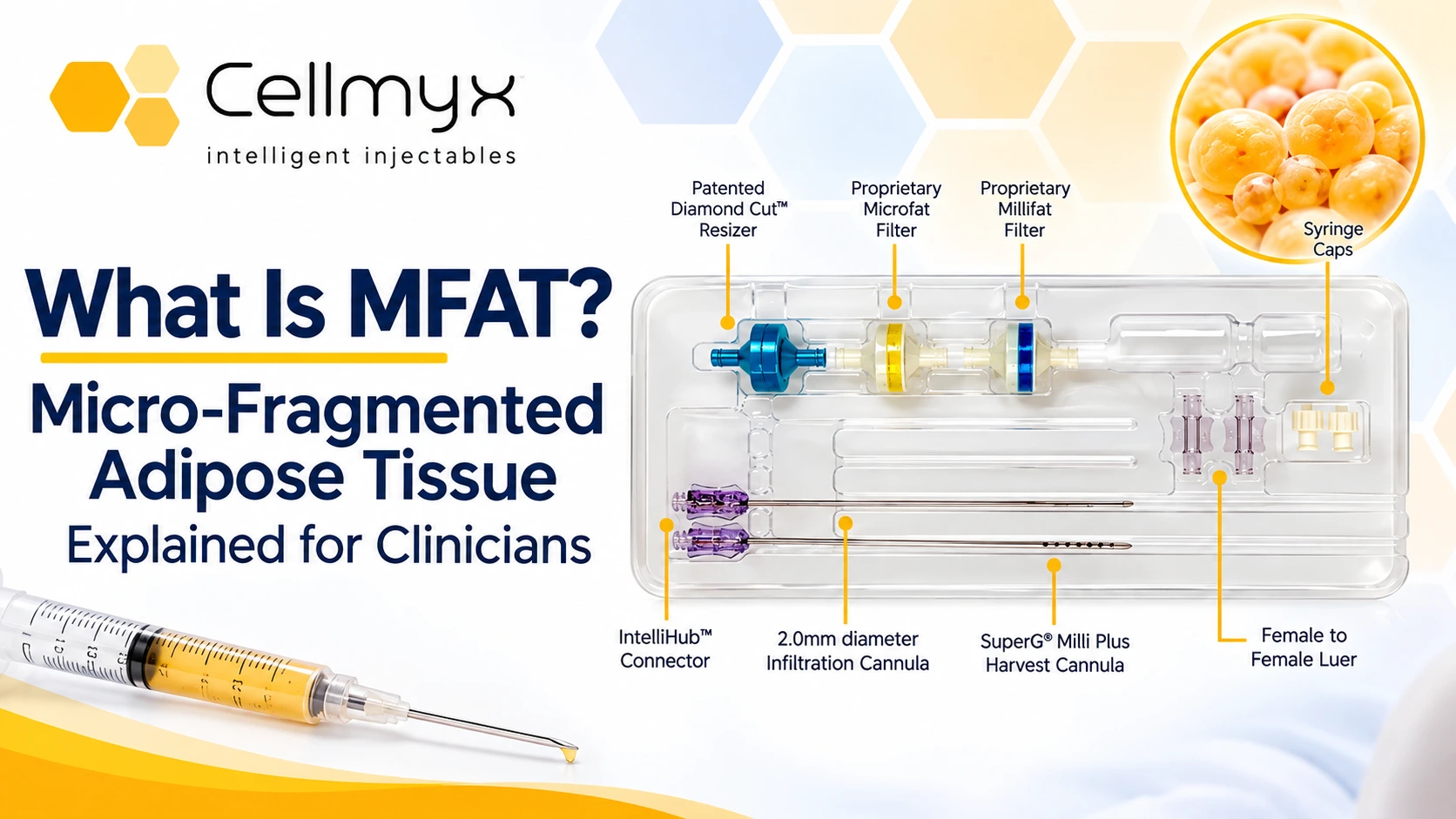
Beyond providing physical volume, fat tissue contains a rich microenvironment of structural support and regenerative cell populations. For healthcare professionals researching autologous tissue-based procedures, asking “what is MFAT” is a critical first step.
Microfragmented fat provides a way to process the patient’s own adipose tissue. It keeps much more of its natural structure at the same time. Knowing about its preparation and the biological contents helps you check its role in modern practice. Also, knowing about its clinical applications and the regulatory considerations helps with it.
MFAT Definition-What the Acronym Means and What it is
MFAT stands for micro-fragmented adipose tissue. It is a more autologous tissue product made from the patient’s own fat. Mechanical processing decreases the much larger fat pieces into much smaller clusters. It preserves the more important parts of the extracellular matrix and the surrounding cellular environment at the same time.
Unlike the more isolated cell preparations, the MFAT keeps a mixture of the adipocytes and the vascular structures. The mixture also includes the supporting cells. Its purpose is to deliver the much more structurally preserved adipose tissue rather than just a more purified stem cell suspension.
How MFAT is Produced
The MFAT procedure involves harvesting and mechanically processing fat under controlled conditions. The process generally includes three stages.
Harvest with minimal manipulation
A clinician collects the adipose tissue through a liposuction procedure using a more suitable cannula. Gentle harvesting helps to keep the tissue structure and restricts a lot of unnecessary damage. The collected fat then enters a sterile processing system.
Closed-system washing and resizing without enzymes
The harvested tissue passes through a closed processing system. Saline washing helps to remove the blood and the oil. It also removes much unwanted fluid. Mechanical movement and the resizing break the much larger fat clusters into much smaller pieces.
This approach avoids enzymatic digestion and cell expansion. It also reduces direct handling when the equipment supports a closed workflow.
Typical fragment size (~500 µm) and yield
Processed MFAT mainly has tissue fragments around 500 microns, although the final size depends more on the processing system and the protocol. Published preparation methods report much more variable yields, with approximately 5–20 mL of the processed tissue from the 50–120 mL of the harvested fat.
What MFAT Contains-Stromal Vascular Niches and Pericytes and Mesenchymal Stromal Cells
MFAT keeps a stromal vascular niche, including many different cell populations and supporting structures. These include the pericytes and the endothelial cells. They also include the fibroblasts and the mesenchymal stromal cells.
Knowing “what is MFAT” also means recognizing how its much more preserved cellular environment differs much more from the isolated cell-based preparations.
These distinct structural and cellular components drive growing biological interest in micro-fragmented adipose tissue (MFAT). Researchers actively investigate how intercellular communication and localized paracrine signaling support tissue repair and modulate inflammatory responses.
However, the presence of regenerative MFAT stem cells does not classify it as an isolated stem cell therapy; rather, the tissue preserves its native, heterogeneous cellular microenvironment rather than relying on purified or culture-expanded cells.
Conditions and Uses Studied
Clinical research explores several potential applications of MFAT. Then also the evidence quality and the treatment outcomes differ more across the conditions.
Knee and hip and shoulder osteoarthritis
Knee osteoarthritis receives much more considerable research attention. Studies check the changes in joint pain and mobility. It also checks the physical function after the MFAT injections and, in turn, helps the researchers assess the potential of the MFAT treatment for the joint conditions. Hip and shoulder osteoarthritis also appear in the clinical research, although the available evidence is much less extensive.
Meniscal injury and tendinopathy
Researchers are also investigating micro-fragmented adipose tissue (MFAT) for treating meniscal injuries and tendinopathies, including rotator cuff pathologies. Its intact tissue architecture and preserved cellular microenvironment provide a strong rationale for ongoing clinical exploration; however, larger-scale controlled trials remain essential to establish consistent, evidence-based outcomes.
Aesthetic and skin applications
Adipose tissue also has applications in soft-tissue restoration and skin procedures. MFAT and other processed fat preparations differ in their fragment size and structure. Their suitability depends more on the intended application and the delivery method.
MFAT vs Nano Fat vs Conventional Fat Grafting
The methods differ mainly in their processing methods and the tissue structure. They also differ in their intended uses. Compared with the more conventional fat grafting, the microfragmented fat undergoes mechanical processing to create much smaller tissue clusters while also keeping the more important structural components.
❖ MFAT-Mechanically resized fat clusters keeping the stromal vascular structures.
❖ Nano fat- more extensively emulsified fat with a much finer consistency and a decreased intact adipocyte structure.
❖ Conventional fat grafting- transfers much larger fat parcels mainly for volume restoration.
The pick depends more on your clinical objective and the tissue needs. It also relies on the equipment available.
Regulatory Landscape (US 510(k) and EU Classification Differences)
In the United States, the FDA 510(k) clearance applies to the more specific medical devices and their stated intended uses. It does not establish the approval of each treatment performed using the equipment.
For example, relevant device clearances appear in FDA records. Check the exact device clearance and the labeling before picking a system each time.
In the European Union, the classification depends more on the processing and the intended use. Substantial manipulation and non-homologous use can bring a product within the Advanced Therapy Medicinal Products framework. Classification can therefore differ much more depending on the procedure and the clinical application.
Equipment for Micronized Fat
Reliable equipment helps in much consistent harvesting and the washing. It also helps in the tissue resizing. When checking a system, consider the more sterile processing and the more controlled handling. Also consider the workflow productivity and the compatibility with the intended procedure.
Cellmyx provides intelliFat equipment options, including the intelliFat BOD for adipose tissue harvesting and the processing workflows. Check the device specifications and the intended use to determine if the system meets your clinical needs.
Key Takeaways
Knowing “what is MFAT” helps clinicians to check its role in regenerative medicine. The mechanical processing and the autologous fat preparation keep the more important tissue structures and the cellular components. Its potential applications include joint and tendon procedures. It also includes soft tissue procedures, although the clinical evidence varies by indication.
Knowing about the processing methods and the equipment needs helps you make more informed clinical decisions. Knowing about the regulatory boundaries also helps in it. Cellmyx provides the equipment information to help clinicians check out the adipose tissue processing options.
Explore Closed System MFAT Processing
Looking for equipment to produce MFAT in a closed system? Request intelliFat information from Cellmyx.
Contact us by calling (949) 215-8560 or emailing [email protected].
FAQs
MFAT stands for micro-fragmented adipose tissue. It is autologous fat that has been gently resized into small clusters while keeping its natural structure.
In published MFAT trials, fat is harvested with minimal manipulation and processed in a closed system with saline and no enzymes. The final product consists of clusters of about 500 microns with intact stromal-vascular niches.
No. MFAT is a tissue graft that retains the native stromal-vascular niche, including mesenchymal stromal cells. It is not an isolated or culture-expanded cell product.
Registered and published studies include knee, hip and shoulder osteoarthritis, meniscal injuries and rotator cuff disease. Evidence strength differs by condition.
Clearance applies to specific devices and indications. For example, Lipogems received FDA 510(k) clearance in 2018 for orthopedic and arthroscopic procedures. Always check the labeling of the device you plan to use.
