
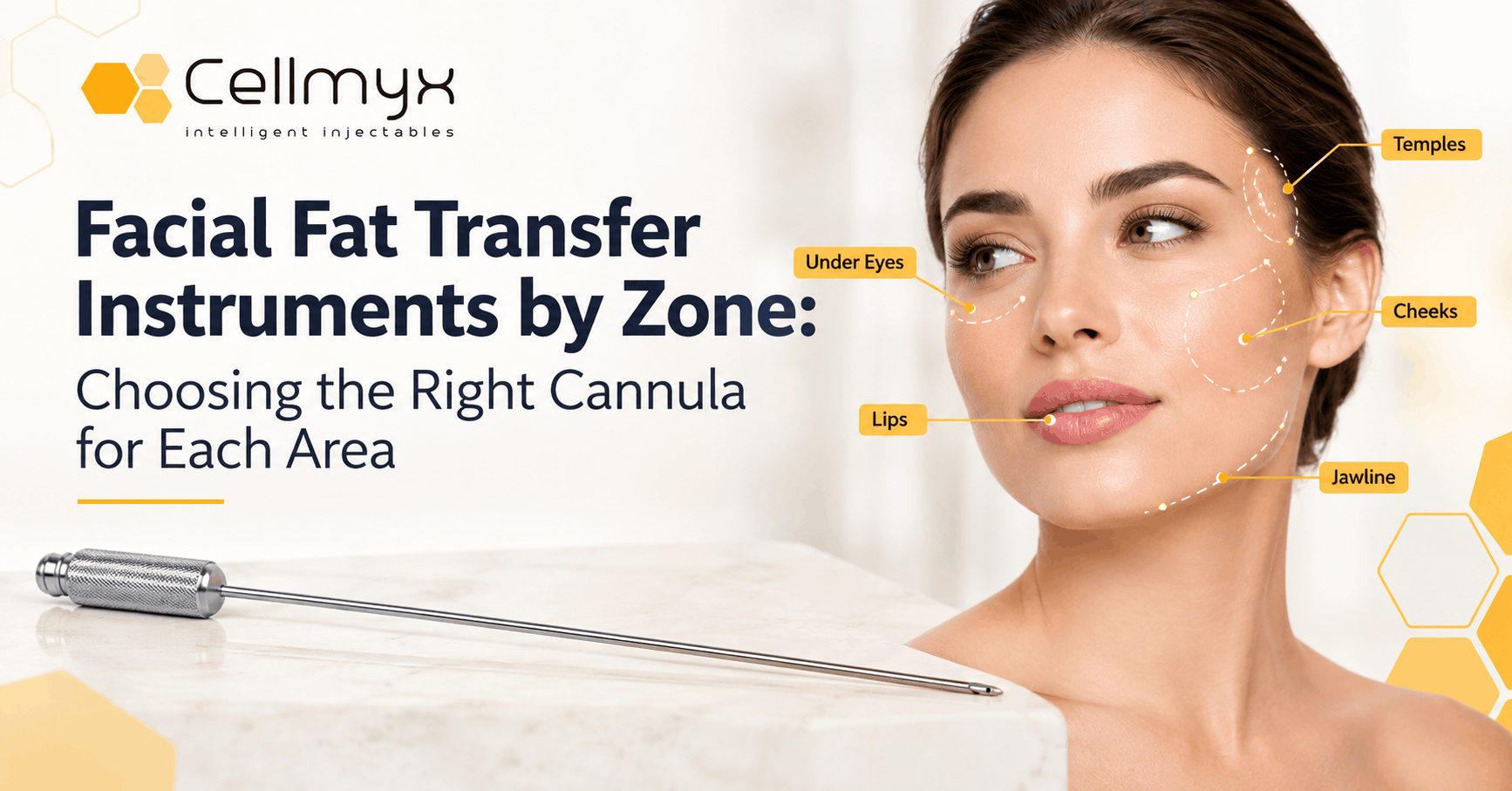
Picking the right instruments for facial fat transfer isn’t something to gloss over — every area of the face behaves differently, with its own tissue quirks, anatomical landmarks, and volume needs. The temples call for careful, measured restoration. The cheeks often need real structural support. And the tear trough? That’s delicate territory where precision really matters, given how thin the tissue is there. Matching your facial fat transfer instruments to the zone you’re actually treating makes a real difference.
Things like cannula diameter, length, flexibility, and port design all play into how fat moves and how much control you have while placing it. Let’s walk through what to consider when choosing cannulas for different facial zones, plus a word on the harvesting and processing side of things.
Why Different Facial Zones Need Different Instruments
Facial anatomy isn’t uniform — the temples, cheeks, lower eyelids, and jawline all look and behave differently under the skin. Cannula choice should take into account tissue thickness, how deep you’re working, the consistency of the fat, and how much control the area demands.
Tissue thickness and plane depth
The cheeks have distinct fat compartments to work around, while the tear trough has thin skin that really doesn’t forgive uneven volume placement. The temples bring their own challenge too, with multiple tissue layers that call for careful anatomical assessment before you even pick up an instrument.
Cannula diameter and length need to suit the plane you’re working in and how the fat’s been prepared. Smaller instruments can work well in certain situations, but whether they’re actually suitable comes down to material compatibility and what the manufacturer specifies.
Vascular anatomy and safety margins
Blood vessels in the face don’t sit in the same spot from patient to patient, and some run uncomfortably close to common treatment areas. Vascular injury and fat embolism are real risks with facial fat transfer, and worth taking seriously. Blunt cannulas can help cut down on certain tissue-cutting risks, but let’s be clear — they don’t make those risks disappear.
Solid anatomical knowledge, proper patient assessment, and sticking to established safety protocols all matter here. No cannula, however well-designed, replaces that groundwork.
Temples
Temple fat transfer can genuinely help bring back volume that’s been lost to aging or changes in facial structure over time. But given how complex the anatomy is in this area, instrument choice needs to reflect that — you want controlled, deliberate delivery, not guesswork.
Typical cannula gauge and length considerations
Length should give you the reach you need from wherever your access point is, and diameter has to accommodate the size and consistency of the fat particles you’re working with. Port configuration and flexibility matter too — they shape how the cannula actually handles in your hand.
When you’re comparing temple fat grafting Cannula options, it’s worth going straight to the manufacturer’s specs and intended use cases. There’s no single gauge or length that works across the board — it really depends on the patient and the procedure.
Technique notes
Temple work demands real attention to tissue planes, your access route, and the vascular structures nearby. The instrument you choose should support controlled placement without putting the surrounding tissue through unnecessary trauma.
The goal here isn’t just to fill the hollow — it’s balanced restoration. This is work that belongs in the hands of appropriately trained clinicians who know the anatomy cold and are prepared to manage complications if they come up.
Cheeks and Midface
The cheeks do a lot of heavy lifting for facial projection and contour, and they shape that transition zone between the lower eyelids and midface. Depending on the patient’s anatomy and what they’re hoping to achieve, fat transfer here might restore lost volume or smooth out specific contour concerns.
Deep vs. superficial placement
Deeper placement tends to help with structural volume, while more superficial placement can address certain contour issues. Which plane makes sense really depends on the individual’s anatomy and what outcome you’re going for.
Cannula choice needs to line up with how the fat’s been prepared and exactly where it’s going. Too much volume, or volume placed unevenly, can leave visible irregularities behind — so the instrument has to support real control, not just delivery.
Fanning and threading approaches
Fanning spreads fat out in multiple directions from one access point, while threading follows a more deliberate, planned path. Either way, you need tight control over both placement and volume.
A good cheek fat grafting technique is about getting the contours right, not about how much you can inject. Cannula design, how much resistance the tissue gives, and the practitioner’s own experience all shape how this plays out.
Tear Trough and Periorbital Area
The tear trough is about as delicate as it gets — the skin is thin, and even small differences in volume show up noticeably on the lower eyelid. This is an area where patient assessment really has to come first, before fat transfer is even on the table.
Fine-bore cannula considerations
Fine-bore cannulas can make sense for certain low-volume applications, as long as they’re compatible with how the fat’s been prepared. But don’t assume a smaller diameter automatically means a safer procedure — that’s not how it works.
When you’re weighing tear trough fat transfer Cannula options, think about the device’s intended use, its port design, and whether it actually works with your graft material. Given the vascular anatomy in this region, proper training and real procedural caution aren’t optional.
Microfat vs. nanofat
Microfat generally keeps the fat particles larger and is used for restoring volume. Nanofat goes through a lot more processing and tends to get used for tissue-quality purposes rather than structural volume work.
These two behave differently and serve different purposes. For microfat injection in Cannula selection, pay attention to particle size, lumen diameter, and the real risk of clogging. The equipment has to actually match what you’re delivering.
Jawline, Chin, and Perioral Area
Fat transfer around the jawline and chin can help restore volume or refine contours in that lower-face area. Perioral treatment, meanwhile, can address some of the volume changes that come with age around the mouth.
Cannula choice here comes down to tissue thickness, how much volume you’re placing, your access route, and the precision the area demands. And don’t forget — the perioral area is constantly in motion, from talking to eating, so careful placement really counts.
Choosing a fat transfer Cannula for face treatments should start with your treatment goal and the patient’s own anatomy. It’s on the practitioner to actually check the device’s specs and whether it fits the job — not assume one cannula handles every part of the face equally well.
Quick Reference Table: Zone vs. Cannula Specification
Here’s a general overview to use as a purchasing reference — not a procedural guide.
| Treatment zone | Key considerations | Primary objective |
|---|---|---|
| Temples | Length, flexibility, controlled delivery | Restore volume |
| Cheeks and midface | Fat compatibility, port design | Improve projection and contour |
| Tear trough | Fine-volume control, device suitability | Address selected hollows |
| Jawline | Reach, flexibility, volume requirements | Refine lower-face contours |
| Chin | Appropriate reach and controlled delivery | Restore or refine projection |
| Perioral area | Precision and anatomical suitability | Address selected volume changes |
At the end of the day, the right cannula depends on the patient’s anatomy, how the fat’s prepared, the clinician’s own expertise, and what the manufacturer recommends. There’s no one-size-fits-all gauge here.
Instruments for Harvest and Processing
Fat transfer isn’t just one step — it’s collection, processing, and injection, each with its own demands. Harvesting cannulas pull the adipose tissue, and processing equipment gets it ready for wherever it’s headed next. Every piece of that chain needs to work together.
When you’re comparing facial fat transfer instruments, look at material quality, port configuration, device specs, and whether everything’s actually compatible with your chosen prep method. Get that right, and you’re set up for consistent handling from start to finish.
Matching harvest cannula to injection cannula
Harvesting and injection cannulas aren’t interchangeable — they do different jobs. You pick the harvesting instrument for collecting fat, and the injection cannula needs to handle the processed material and get it where it’s going.
If the fat particles don’t match up with the injection cannula, you’re looking at inconsistent delivery or outright blockages. And pushing harder isn’t the fix — that’s not a substitute for having the right equipment matched up in the first place.
For microfat injection Cannula work, check particle compatibility and stick to the manufacturer’s instructions. It helps to look at the whole workflow, from collection through to injection, rather than picking equipment piece by piece.
Conclusion: Browse Facial Fat Transfer Cannulas
Choosing the right facial fat transfer instruments really comes down to understanding the anatomy, knowing your treatment goals, paying attention to fat consistency, and matching cannula specs to the job. The temples, cheeks, tear trough, jawline, and perioral area all ask for something a little different, which is exactly why zone-specific thinking matters here.
Cellmyx is a provider worth putting on your list when you’re comparing fat transfer cannulas and related equipment. Take the time to review product specs, intended uses, and how well they fit into your harvesting and processing workflow before you commit to a purchase.If you’re in the middle of evaluating facial fat transfer instruments, start with your clinical requirements, then compare your options against the documented specs and manufacturer guidance. A little care up front goes a long way toward choosing instruments that actually fit what you’re trying to do.
Frequently Asked Questions
Fine-bore, blunt-tip cannulas are commonly used for tear trough fat transfer because the skin around the eyes is exceptionally thin and delicate. The surgeon selects the appropriate cannula size and fat preparation method based on the patient’s anatomy and the procedure’s requirements.
Temple fat transfer typically involves making a small entry point and using a blunt cannula to place carefully measured amounts of fat in the planned tissue plane. The surgeon determines the appropriate depth, injection pattern, and volume according to the patient’s anatomy and treatment goals.
Using one cannula for every facial area may not provide the control or access a surgeon needs. Different facial zones have varying tissue thicknesses and anatomical features, so having several cannula lengths and gauges helps practitioners select suitable instruments for each procedure.
Facial fat transfer uses fat harvested from the patient’s own body, which is then processed and injected into selected facial areas. Dermal fillers, by contrast, are manufactured injectable products that require no fat harvesting. Both treatments can restore volume, but their suitability depends on individual needs.
